How to Choose Reliable Service Providers for HOAs
Homeowners Associations (HOAs) rely heavily on vendors to fulfill a broad range of essential community needs including landscaping, property maintenance, security, legal support, and financial management. Reliable service providers are foundational to maintaining community safety, aesthetics, legal compliance, and resident satisfaction. According to industry standards, HOAs allocate approximately 20% to 40% of their operational budget towards vendor services covering these various categories. Choosing vendors who deliver inconsistent or poor-quality service can lead to costly rework, service interruptions, diminished property values, and frustrated residents—all of which harm the community’s reputation and livability.
A strategic and informed approach to vendor selection helps ensure the community receives reliable, value-driven services aligned with its unique needs.
Defining Your HOA’s Vendor Requirements and Priorities
The first step in selecting reliable vendors is to define the services your HOA requires clearly. Organize these into categories such as:
Landscaping: lawn care, tree trimming, irrigation
Property Maintenance: plumbing, electrical, HVAC, general repairs
Security: patrol, surveillance, access control
Cleaning: janitorial services for common areas
Legal and Financial Services: legal counsel, bookkeeping, auditing
Community Services: event management, amenities upkeep
Prioritize these services by importance, categorizing them as high, medium, or low—based on community needs, resident feedback, and compliance requirements. Engaging HOA board members, committee chairs, and property managers ensures all critical services are identified.
Detailed documentation of service scope and task expectations facilitates clear communication with vendors and provides benchmarks to gauge performance later.
Building and Using an HOA Vendor Matrix for Vendor Selection
An HOA vendor matrix is a powerful organizational tool to systematically track and evaluate vendors for each required service. Steps to build and use it include:
Compile Vendors: Identify primary and backup vendors for each service category.
Set Evaluation Criteria: Experience, pricing, reliability, certifications, insurance, references.
Rank Vendors: Score and rank vendors to shortlist 2-3 best options per service.
Manage Performance: Use the matrix as a living document updated annually with performance reviews and community feedback.
Benefits of a vendor matrix include consistent service quality, faster vendor replacement during emergencies, and easier comparison for informed decision-making.
Vetting and Evaluating Potential Service Providers
Thorough vetting minimizes the risk of hiring unreliable vendors. Include:
License and Certification Verification: Confirm active and appropriate licenses, industry certifications, bonding, and proof of insurance.
Reference Checks: Request references from HOAs similar in size and scope to your own community.
Online Ratings: Check Better Business Bureau (BBB), Google Reviews, industry platforms.
Interviews: Discuss service approach, emergency response, flexibility, dispute resolution.
Site Visits: Observe ongoing work at current client sites to inspect quality and professionalism.
Performance Scorecards: Utilize third-party audits or HOA-specific vendor scorecards where available.
This multi-layered process ensures vendors meet professional and community standards.
Drafting and Issuing Detailed Requests for Proposal (RFPs)
An RFP is a formal document that outlines your HOA’s specific needs and requests competitive vendor bids. Critical elements include:
Detailed Scope: Clear description of work, deliverables, timelines, and standards.
Required Vendor Documentation: Proof of licenses, certificates, insurance, financial stability, and client references.
Proposal Guidelines: Submission deadlines, evaluation criteria, and contact information.
Customizing the RFP to align with your HOA’s culture and priorities improves the quality of responses and vendor fit.
Reviewing and Comparing Vendor Proposals
Evaluate proposals using a comprehensive approach:
Price Transparency: Ensure detailed cost breakdowns without hidden fees.
Scope and Completeness: Assess if the vendor fully addresses all requirements.
Service-Level Agreements (SLAs): Look for response times, warranties, penalties.
Vendor Capacity: Verify ability to manage your HOA size and needs, with contingency plans.
Using a scoring matrix allows objective appraisal, while focusing on value and reliability over simply the lowest cost.
Trial Periods and Performance Monitoring
Before full commitment, consider a trial period or pilot service with selected vendors. Key performance indicators (KPIs) to assess include:
Response Time: How quickly vendors acknowledge and resolve service requests.
Quality of Work: Inspection of completed tasks against standards.
Resident Satisfaction: Feedback from community members.
Communication Efficiency: Promptness and transparency in updates.
Use vendor scorecards and digital dashboards for transparent ongoing monitoring and timely intervention if issues arise.
Building and Maintaining Long-Term Vendor Relationships
Long-term partnerships yield better responsiveness, understanding, and potential cost savings. Best practices include:
Ongoing Communication: Regular check-ins, performance discussions, and feedback.
Vendor Training: Educate vendors about HOA-specific processes and expectations.
Flexibility: Collaborate on service improvements and adaption to community changes.
Recognition: Acknowledge quality service to foster loyalty.
Keep vendor matrices and contracts updated based on ongoing review and resident satisfaction.
Risk Management and Contingency Planning
Mitigate risks by:
Contract Clauses: Include clear terms on termination, dispute resolution, and penalties.
Insurance Verification: Ensure vendors maintain appropriate liability and workers' compensation coverage.
Backup Vendors: Maintain alternative providers in your vendor matrix.
Emergency Plans: Define protocols for service disruptions or vendor failure to minimize impact.
Proactive risk and contingency planning safeguard HOA operations and finances.
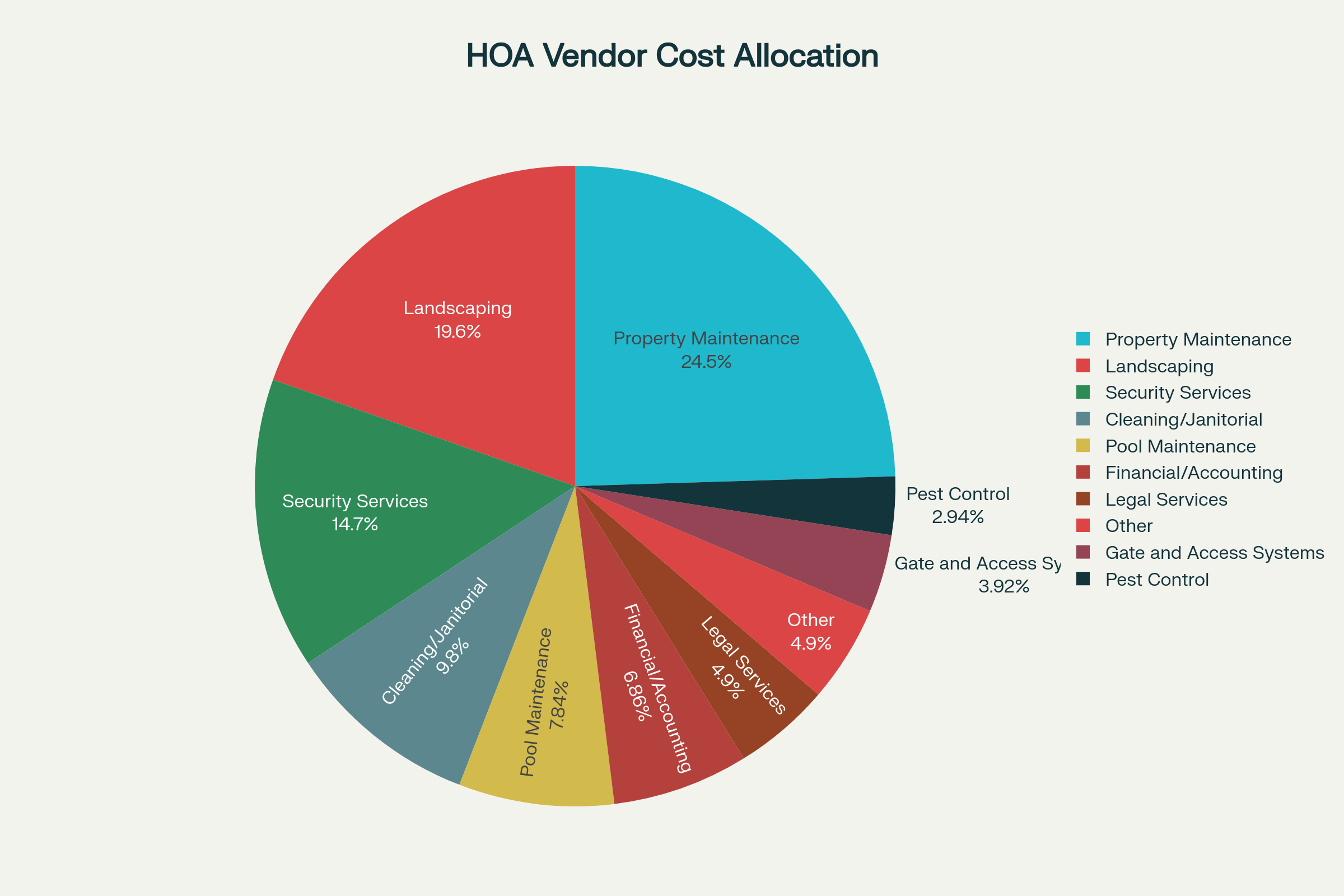
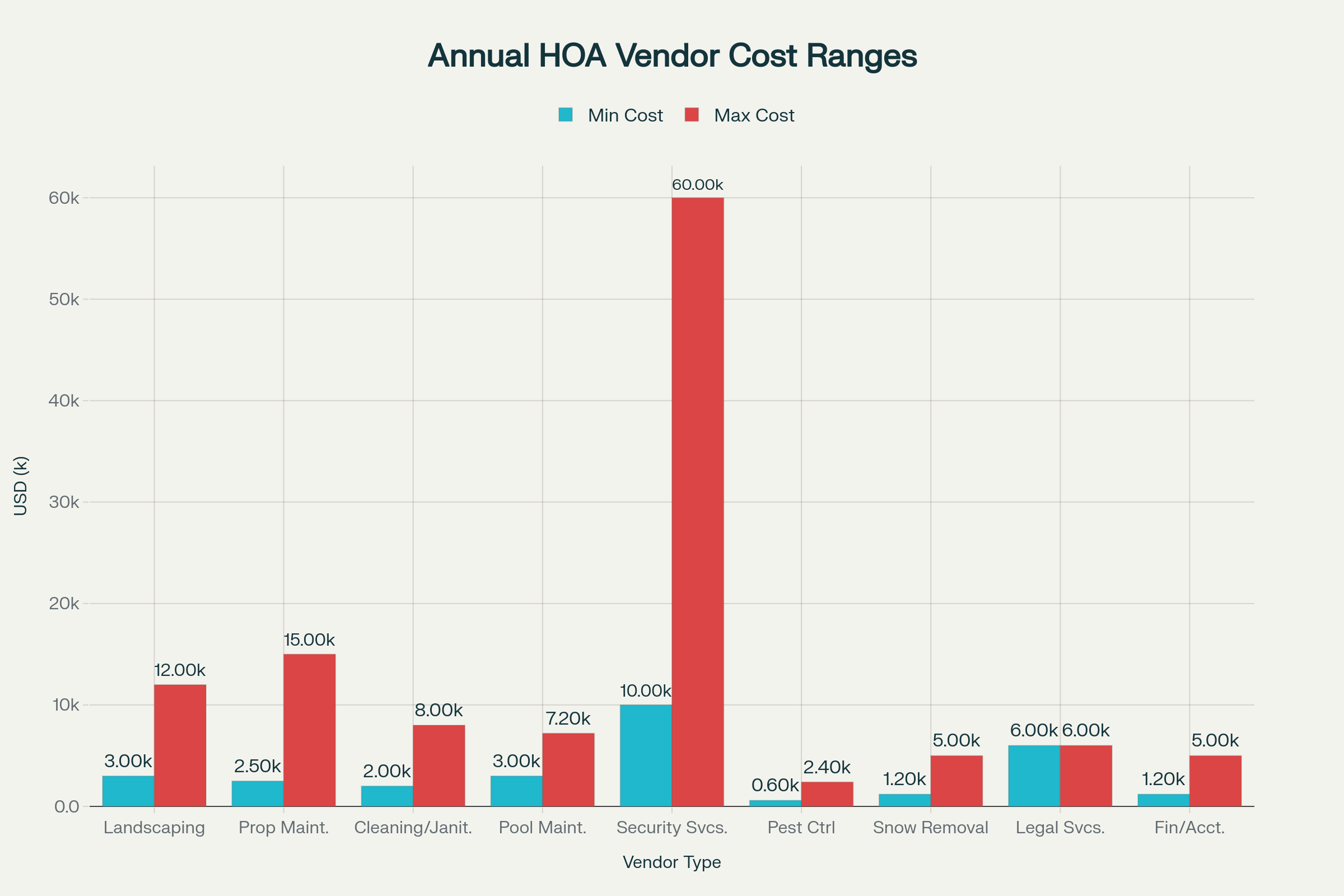
How much does each HOA vendors cost?
Vendor Type | Services | Est. Cost Range | HOA Budget Allocation % |
Landscaping | Lawn care, irrigation, tree trimming | $3,000 – $12,000 | 20% |
Property Maintenance | Repairs, HVAC, plumbing, electrical | $2,500 – $15,000 | 25% |
Cleaning / Janitorial | Common area cleaning, pressure washing | $2,000 – $8,000 | 10% |
Pool Maintenance | Pool cleaning, chemical balancing, equipment checks | $3,000 – $7,200 | 8% |
Security Services | Patrols, surveillance, access control | $10,000 – $60,000 | 15% |
Pest Control | Sprays, inspections, termite prevention | $600 – $2,400 | 3% |
Snow Removal | Seasonal snow plowing, ice control | $1,200 – $5,000 (seasonal) | 2% |
Legal Services | Consultations, dispute resolution | $150 – $400 per hour; retainer varies | 5% |
Financial / Accounting | Bookkeeping, auditing, tax preparation | $1,200 – $5,000 | 7% |
Event and Community Services | HOA event planning and execution | $500 – $3,000 per event | <1% |
Environmental Consulting | Sustainable practices, landscape design | Hourly/project-based | <1% |
Insurance Providers | HOA insurance policies | $500 – $5,000+ | <1% |
Gate and Access Systems | Installation and maintenance of gates, key fobs | $2,000 – $15,000 initial; maintenance | 4% |
*Percentages reflect typical cost allocations within the vendor services budget and may vary based on HOA size and priorities.
Conclusion: Establishing a Reliable Service Provider Framework
Choosing and managing HOA service providers reliably requires a methodical, data-driven approach built on:
Clear identification and prioritization of vendor needs
Use of a vendor matrix for organized selection and backup planning
Detailed, tailored RFPs to attract well-suited vendors
Objective proposal review with attention to value and service quality
Trial periods with defined KPIs for real-world vetting
Ongoing performance tracking and relationship building
Robust risk management and service continuity planning
Following these best practices fosters dependable services, safeguards budgets, and enhances resident satisfaction—key pillars for a thriving HOA community.
If desired, I can provide templates for vendor matrices, RFPs, vendor scorecards, and other tools tailored to your HOA’s needs to help implement this framework efficiently.
 Made with Levo